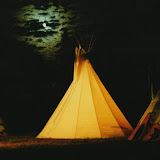
The truth about teepees
I have recently been employed by a Native company, and have learned amazing things about their philosophy, culture and traditional way of life. Among other things I have learned a lot about teepees, as a traditional as well as a contemporary teepee dwelling. I did not know much about these dwellings before working for Mukwa Teepees. For me, a teepee was a traditional shelter that belonged to the past. I used to think it had not contemporary uses appart from ceremonial and symbolic. I also used to think that a teepee was like a tent, just bigger. But, the more I am reading about teepees and the more I am experiencing teepee living, the more I realise that it is not true. Here are some of what I have learned about teepees, that I would like to share with you.
A 10,000 years old technology developed to perfection.
Teepees have originally designed as portable housing for a travelling lifestyle. In a way they could be said to be North America's earliest RV, without the greenhouse gas emissions. They have been developed over ten thousand years of testing in nearly all the climates of North America(1). The ideal portable home, they can be warm in cold winters
 and cool in hot summers(2). Indeed, traditional Native teepees are very energy efficient with their integrated heating/cooling technology.
In the spring and summer, they can positioned be solar heated during the day, and keep the heat inside for a warm sleep during the night. The part facing the sun would then be light coloured, to let the light in, and the back of the teepee darker, to keep the heat in. If it gets too hot, simple adjustments in the setting of the teepee creates natural ventilation from the natural air movements from the bottom of the teepee out through its chimney. In the fall and winter, a small fire, made from dead branches, is enough to comfortably heat the living space and the teepee can be insulated well enough for comfort even in snow-covered plains. For the best indoor air quality, teepee dwellers would use the smoke flap to channel a breeze inside the teepee. If it starts to rain, control ropes allow the inhabitants to close the flaps from inside the teepee. This traditional dwelling is also a great reflection of the love for Mother Earth of the people who used to live in it. Its conical shape with a ciruclar floor space is more reflective of the shapes founds in nature, versus the angular and square objects of Western urban life. It also allows a greater connection with the surrounding beauty of nature, and, at the same time, protection from its harshness(3). Teepee camps would often be located close to water, for practical reasons (to drink, and wash) but also for comfort reasons. Indeed, water creates a low fresh breeze of air that can get in the teepee when the draft skirt is lifted, creating natural air conditioning. Grass is the traditional flooring for a teepee, with some furs to keep the sleep warm in the winter. Unlike most other dwellings, the teepee let's the earth breathe, so when leaving their camp site, teepee-living nations would leave with virtually no environmental impact.
Contemporary teepee uses
A return to the roots
Teepees were the traditional dwelling of the most spread First Nations of North America, as they were linked to a nomadic lifestyle. Still, it can be said that the majority of the Nations on Turtle Island, as the aboriginal call this continent, did not live in teepees. But their awe inspiring aesthetics, and their important presence in references to Aboriginal culture turned them in a symbol. Now, as part of the cultural revival movement among First Nations, Native Americans beyond the ones who traditionally used this form of architecture are using teepees for cultural activities and ceremonial purposes(4).
A green retreat
Teepees are a very safe and practical shelter, they are dry in rainy weather, safe in the severest windstorms, and earthquake proof. On top of that, they are among the most environmentaly friendly dwellings. No surprise that they are still relevant today as an alternative housing option.
Increasing numbers of resorts and nature lodges offer teepee lodging options, giving their clients the chance of an unforgettable experience of reconnection with nature. The "Priceless" Mastercard competition even saw a weekend in a teepee voted as the most priceless experience (5).
Tepees are also popping up in peoples' backyards as an easy way to return to nature and get away from the stress of modern life. They can also serve as an original temporary guest house extension, or summer patio(4).
Because of their prevalent place in the mind of non-Natives as a symbol of the Aboriginal lifestyle, teepees are an ideal way to use cliches in order to break them. Aboriginal cultural workshops using teepees, field trips in teepee camps, or Aboriginal studies programs for school children, all have a common goal: inspiring a better understanding of Aboriginal culture. When people realize the sophisticated technology behind teepees and how it is linked to a philosophy of respect for nature, they open their mind to the Aboriginal culture. Many then become curious about it, which promotes exchanges and respect between non-Aborginal people and Aboriginal people (6).
Contemporary architecture inspired by teepees
In recognition of the teepee's status as an ideal for green alternative housing, many architects worldwide are studying them in order to reproduce the efficient qualities of the teepee in "modern" dwellings. I have recently found a very beautiful example of teepee-inspired architecture in the UK: http://www.dugganmorrisarchitects.com/
Mukwa Teepees and Teepees at school
If you would like to learn more about teepees, contact Giwise Inini. He is from the Anishnabe Nation, and is always happy to teach people of all ages and all backgrounds about the traditional dwelling of his nomadic Nation of Turtle Island. He is the one who gave me the chance to discover teepees. His email is: mukwateepees@shaw.ca
(1)http://www.mukwateepees.com
(2)http://hubpages.com/hub/Living-in-a-Tepee
(3)http://www.kstrom.net/isk/maps/houses/tipi.html
(4)http://www.associatedcontent.com/article/1171130/tipi_living_could_the_cadillac_of_tents.html?cat=37
(5)http://www.newswire.ca/fr/releases/archive/July2008/16/c4954.html
(6)htttp://www.teepeesatschool.com